

i spent most of my life not realizing that i was living with complex trauma. when i began therapy at the age of 21, i’d left yet another abusive relationship and i was a hot mess of daily panic attacks. despite having read all of the freud, i couldn’t understand why i continued to find myself in relationships with humans who were emotionally volatile or emotional zombies. turns out i was trying to heal the wounds in my family of origin. eventually, i found my way to my first safe partnership.
it would take another decade before i realized that i needed to be in therapy that would specifically address the traumas i experienced: my mother’s death, rape and sexual assault, emotional abuse and neglect in my family of origin, becoming a young caregiver, and my family’s poverty. the past eight years have been some of the most transformational of my life and i truly can’t wait to see what my 40s hold in store for me.
my story

I believe it’s important to situate myself in the work I do.
i’m a nonbinary queer person from a poor family, a trauma survivor and someone living with chronic illness. i’m also a white settler on the unceded Indigenous land of the Tongva people in what is colonially known as los angeles. as a white settler on this land, and one committed to addressing and healing from trauma, it is vital that i acknowledge the ways in which settler colonialism has caused intergenerational trauma within Indigenous communities since first contact and continues to do so today.
My lineages
thanks to various trainings, workshops, and courses, i’ve had the great honor to learn directly from those in the social justice and healing justice movements, including adrienne maree brown, Sonya Renee Taylor, Kai Cheng Thom, Nkem Ndefo, Staci K. Haines, Rev. angel Kyodo williams, Patrisse Cullors, Rusia Mohiuddin, and Resmaa Menakem. all of these humans have opened me up to challenging the ways in which white supremacy lives within me and directs my movements; they have provided me with their radical visions for a world that is interdependent, loving, pleasurable, and just. these teachers have helped me grow as a facilitator, showing me that it is possible to practice intentional adaptation and shift course from business as usual, that i do not need to offer closure or all of the answers to questions that are complex and, in many ways, unanswerable.
-
I am also deeply grateful to those working in the field of somatics, who I have learnt from formally and informally through their writing and work in the world, some of whom were listed above. This lineage also includes: Deb Dana, Prentis Hemphill, Janina Fisher, Peter Levine, Fran D. Booth, Arielle Schwartz, Stephen Porges, Richard Schwartz, Kekuni Minton, and Karine Bell. They have supported my own trauma healing and enabled me to craft ways of being in relation to others — as teacher, as friend, as partner — that are trauma-informed.
Those working in disability justice have also been such crucial teachers for me as I learnt what it meant to be a chronically ill, disabled human in the world. In particular, the work of Leah Lakshmi Piepzna-Samarasinha, Patty Berne, Alison Kafer, and Mia Mingus. Unlearning the ways in which internalized ableism lives within me has enabled me to recognize that access needs don’t just benefit those of us who’re disabled, they benefit everyone. Disability justice helps us all see that the care deficit that exists has been manufactured by racial capitalism. We all deserve care that enables us to not just survive but thrive.
And finally, my gratitude to the abolitionists and those working in transformative justice. Finding those committed to TJ and police and prison abolition has given me the language I needed to express my deep desire to transform the conditions that enable harm and abuse to happen in the first place. I believe that there are no “bad” or “good” people — just people trying to survive. We all have the capacity for transformation. Thank you to Kai Cheng Thom, Mia Mingus, Leah Lakshmi Piepzna-Samarasinha, adrienne maree brown, and Rania El Mugammar for the examples you have offered the world.
-
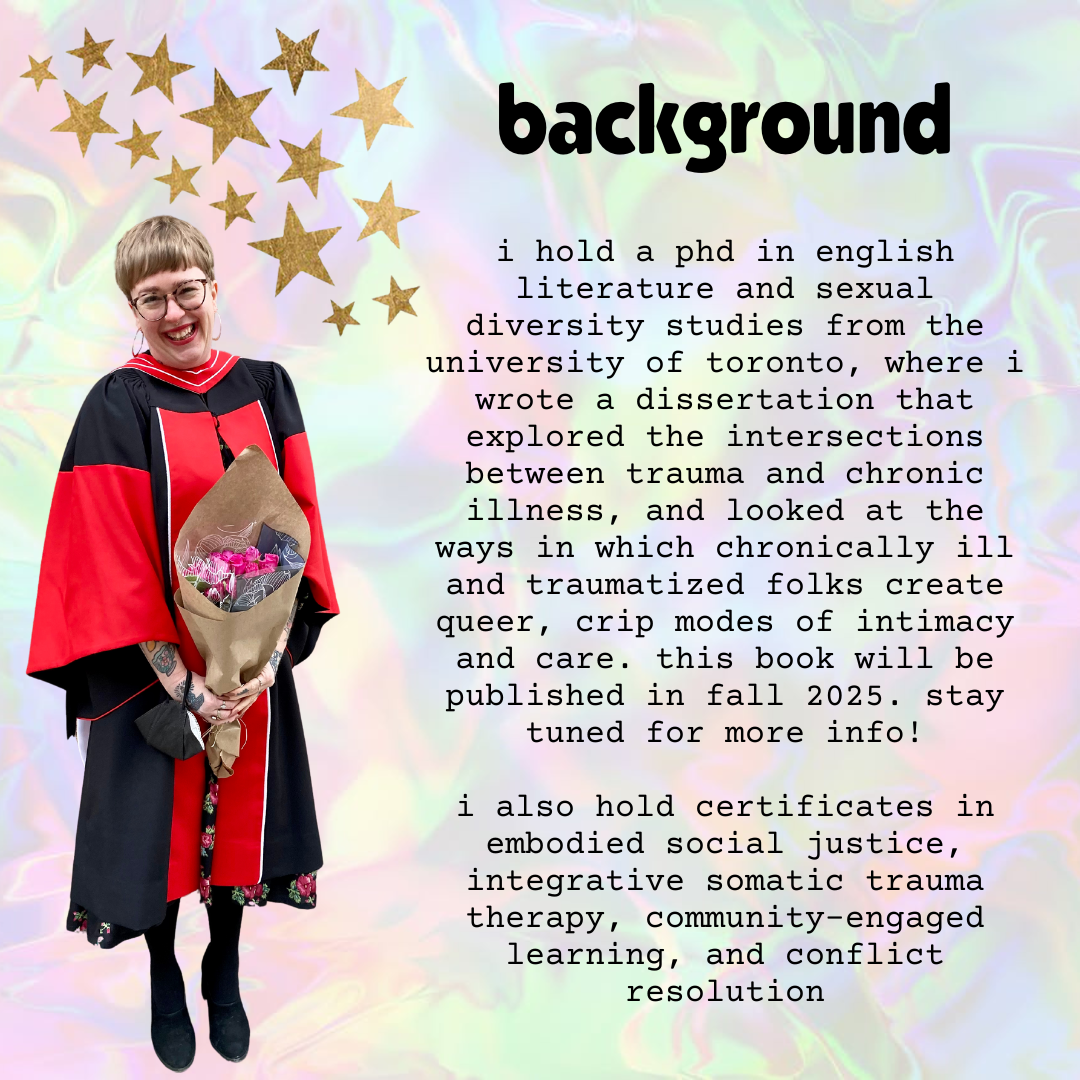
Margeaux Feldman (they/them) is a multidisciplinary artist and educator who uses creative writing, visual art, and social technologies to promote mental health. Their artistic practice focuses on experiences of living with complex trauma and chronic illness. Margeaux holds a MFA in Creative Writing at California Institute of the Arts (2025) and a PhD in English Literature and Sexual Diversity Studies from the University of Toronto (2021). Margeaux is the author of the book, Touch Me, I'm Sick: A Memoir in Essays, forthcoming with Beacon Press (September 9, 2025). Margeaux’s essays, art, and book reviews have been published in The Sonora Review, GUTS Magazine, The Ex-Puritan, and Rabble, amongst others. They run the popular instagram meme account @softcore_trauma.
-
Integrative Somatic Parts Work Certificate, 16 hrs, The Embody Lab (in process)
Embodied Social Justice Certificate, 60 hrs, Transformative Change, 2022
Integrated Somatic Trauma Therapy Certificate, 60 hrs, The Embody Lab, 2022
PhD in English Literature and Sexual Diversity Studies, University of Toronto, 2021
Certificate in Conflict Resolution, University of Toronto, 2017
Certificate in Community-Engaged Learning, University of Toronto, 2015
Numerous transformative justice trainings with Mia Mingus, Karen BK Chan, and Rania El Mugammer.
Suicide and crisis intervention training with Carly Boyce, Project LETS, and the University of Toronto

how i work
As an educator and life-long learner, it is my (unpopular) opinion that learning is impossible without failure.
and so i encourage those learning with me to resist the urge to fake it til you make it, admit when we need help, and to be gentle with ourselves when we mess up.
over the past 15 years, i've cultivated a community-focused teaching practice that is founded upon a commitment to non-mastery, anti-oppression, and equity. now what do all of those jargony words mean?
-
How often do you feel like you gotta “fake it til you make it"? This impulse is soooooooo natural. But it promotes an approach to learning that is focused on individual achievements and turns us into our own worst critics. When we're stuck in the mastery-mindset we create real barriers to ourselves and others, and it's hard to truly grow. Part of the work that I do in my teaching is help you let go of the impulse to perform mastery and become curious about the possibilities that emerge when we admit the limits of our knowledge.
-
We all come into the world with different experiences based on our race, gender, sexuality, class, ability, ethnicity, and religion. As a white person, I believe I must always situate myself in relation to others: how might I have more opportunities to be heard as a white person than a woman of colour? How can I use my power and privilege to enact the change that I want to see in the world? These are the questions that led me to develop workshops and services that you’ll find here.
-
If inclusivity’s goal is to make sure everyone has a seat at the table, the goal of equity is to assess the table and rebuild anew. We do this by getting at the roots of systems of oppression, centring the needs of the most marginalized, and letting them build the table. Equity isn’t a checklist that we go over after we’ve planned an event. Equity is at the centre of the process from the very beginning. When we approach learning from a commitment to equity, we have to analyze our power, privilege, and oppressions and know when to step up or step back.
-
To better my work as an educator with a commitment to social justice, I’ve completed numerous trainings, including:
a Certificate in Community-Engaged Learning
a Certificate in Conflict Resolution
numerous transformative justice workshops, including those facilitated by Rania El Mugammar, Mia Mingus, and Karen B. K. Chan
trauma-informed facilitation
suicide and crisis intervention with Carly Boyce and Project LETS
territorial land acknowledgments
numerous anti-oppression workshops
